
Explain one way each of the following problems might affect TSE when entering a new market in another country. Cultural differences: . Explanation: . . . . . Lack of knowledge: . Explanation: . . . . .
Exam No:0450_s25_qp_22 Year:2025 Question No:1(a)
Answer:
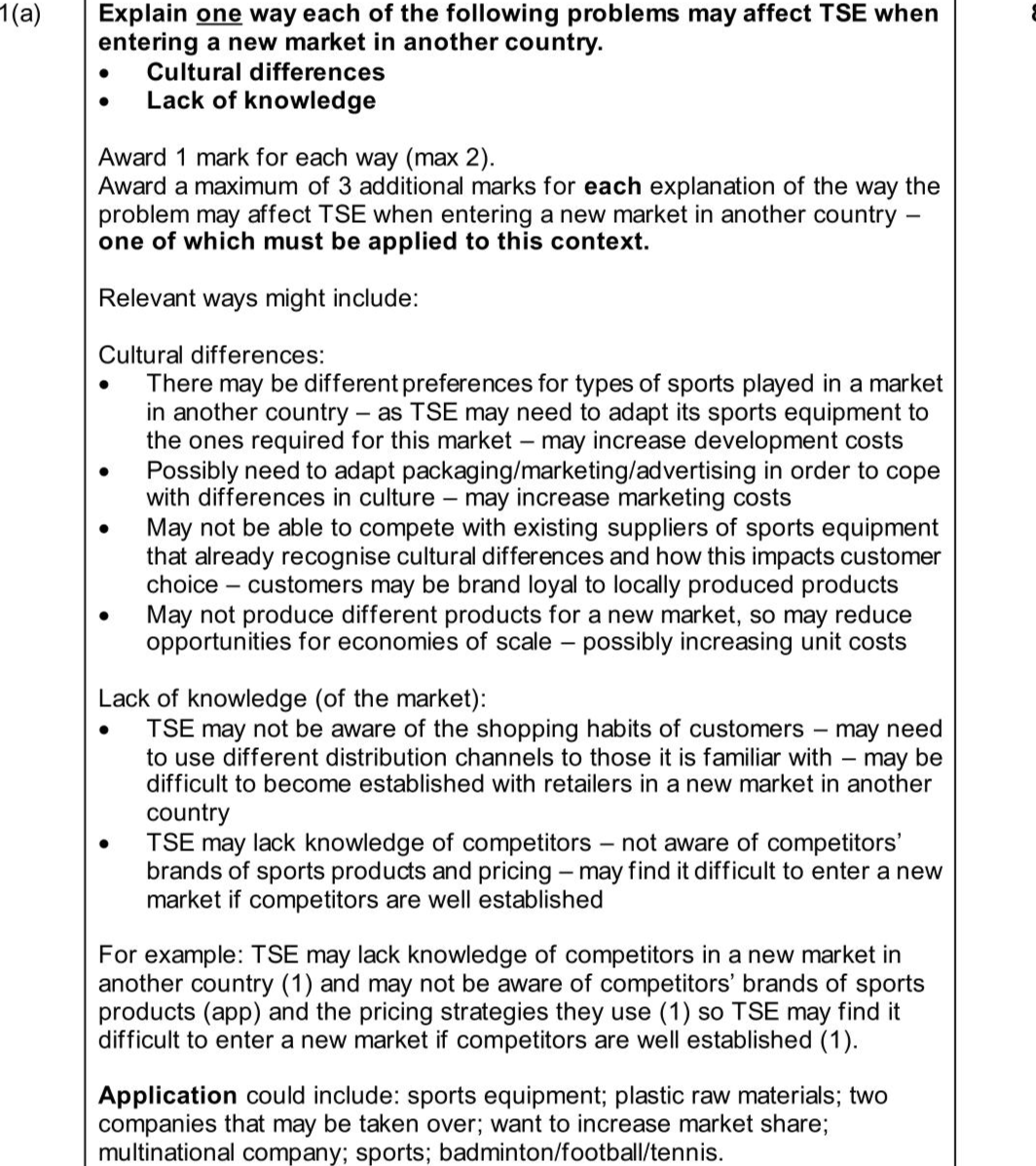
Award 1 mark for each way (max 2).
Award a maximum of 3 additional marks for each explanation of the way the problem may affect TSE when entering a new market in another country one of which must be applied to this context.
Relevant ways might include:
Cultural differences:
- There may be different preferences for types of sports played in a market in another country - as TSE may need to adapt its sports equipment to the ones required for this market - may increase development costs
- Possibly need to adapt packaging/marketing/advertising in order to cope with differences in culture - may increase marketing costs
- May not be able to compete with existing suppliers of sports equipment that already recognise cultural differences and how this impacts customer choice - customers may be brand loyal to locally produced products
- May not produce different products for a new market, so may reduce opportunities for economies of scale - possibly increasing unit costs
Lack of knowledge (of the market):
- TSE may not be aware of the shopping habits of customers - may need to use different distribution channels to those it is familiar with - may be difficult to become established with retailers in a new market in another country
- TSE may lack knowledge of competitors - not aware of competitors' brands of sports products and pricing - may find it difficult to enter a new market if competitors are well established
For example: TSE may lack knowledge of competitors in a new market in another country ( 1 ) and may not be aware of competitors' brands of sports products (app) and the pricing strategies they use (1) so TSE may find it difficult to enter a new market if competitors are well established (1).
Application could include: sports equipment; plastic raw materials; two companies that may be taken over; want to increase market share; multinational company; sports; badminton/football/tennis.
Award a maximum of 3 additional marks for each explanation of the way the problem may affect TSE when entering a new market in another country one of which must be applied to this context.
Relevant ways might include:
Cultural differences:
- There may be different preferences for types of sports played in a market in another country - as TSE may need to adapt its sports equipment to the ones required for this market - may increase development costs
- Possibly need to adapt packaging/marketing/advertising in order to cope with differences in culture - may increase marketing costs
- May not be able to compete with existing suppliers of sports equipment that already recognise cultural differences and how this impacts customer choice - customers may be brand loyal to locally produced products
- May not produce different products for a new market, so may reduce opportunities for economies of scale - possibly increasing unit costs
Lack of knowledge (of the market):
- TSE may not be aware of the shopping habits of customers - may need to use different distribution channels to those it is familiar with - may be difficult to become established with retailers in a new market in another country
- TSE may lack knowledge of competitors - not aware of competitors' brands of sports products and pricing - may find it difficult to enter a new market if competitors are well established
For example: TSE may lack knowledge of competitors in a new market in another country ( 1 ) and may not be aware of competitors' brands of sports products (app) and the pricing strategies they use (1) so TSE may find it difficult to enter a new market if competitors are well established (1).
Application could include: sports equipment; plastic raw materials; two companies that may be taken over; want to increase market share; multinational company; sports; badminton/football/tennis.
Knowledge points:
6.3.1.1. The concept of globalisation and the reasons for it
6.3.1.2. Opportunities and threats of globalisation for businesses
6.3.1.3. Why governments might introduce import tariffs and import quotas
6.3.2.1. Benefits to a business of becoming a multinational and the impact on its stakeholders
6.3.2.2. Potential benefits to a country and/or economy where a MNC is located, e.g. jobs, exports, increased choice, investment
6.3.2.3. Potential drawbacks to a country and/or economy where a MNC is located, e.g. reduced sales of local businesses, repatriation of profits
6.3.3.1. Depreciation and appreciation of an exchangerate
6.3.3.2. How exchange rate changes can affect businesses as importers and exporters of products, e.g. prices, competitiveness, profitability (exchange rate calculations will not be assessed)
Solution:
Download APP for more features
1. Tons of answers.
2. Smarter Al tools enhance your learning journey.
IOS
Download
Download
Android
Download
Download
Google Play
Download
Download