
Iron ore contains iron(III) oxide, $$\(\mathrm{Fe}_{2} \mathrm{O}_{3}\)$$. A blast furnace is used to extract iron from $$\(\mathrm{Fe}_{2} \mathrm{O}_{3}\)$$. Equations for some of the reactions in the blast furnace are shown. Both iron(III) oxide and aluminium oxide contain metal ions with a 3+ charge. (i) Write the electronic configuration of an $$\(\mathrm{A} l^{3+}\)$$ ion. ................................................................................................................................... (ii) Deduce the number of protons and electrons in an $$\(\mathrm{Fe}^{3+}\)$$ ion.
Exam No:0620_m24_qp_42 Year:2024 Question No:1(f)
Answer:
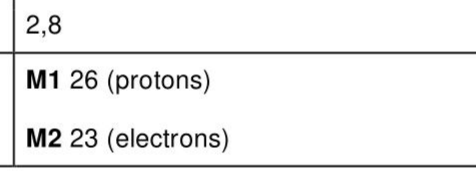
Knowledge points:
9.6.1. Describe the ease in obtaining metals from their ores, related to the position of the metal in the reactivity series
9.6.2.1. the burning of carbon (coke) to provide heat and produce carbon dioxide
9.6.2.2. the reduction of carbon dioxide to carbon monoxide
9.6.2.3. the reduction of iron(III) oxide by carbon monoxide
9.6.2.4. the thermal decomposition of calcium carbonate / limestone to produce calcium oxide
9.6.2.5. the formation of slag Symbol equations are not required
9.6.3. State that the main ore of aluminium is bauxite and that aluminium is extracted by electrolysis
9.6.4.1.
9.6.4.2.
9.6.4.3.
9.6.4.4.
9.6.4.5.
9.6.5.1. the role of cryolite
9.6.5.2. why the carbon anodes need to be regularly replaced
9.6.5.3. the reactions at the electrodes, including ionic half-equations
Solution:
Download APP for more features
1. Tons of answers.
2. Smarter Al tools enhance your learning journey.
IOS
Download
Download
Android
Download
Download
Google Play
Download
Download