
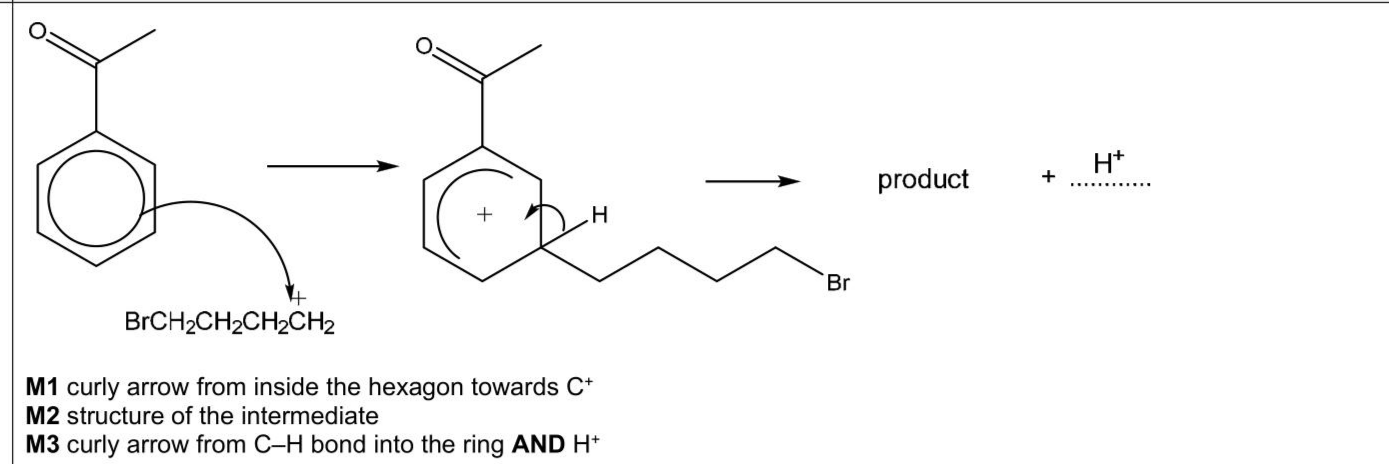
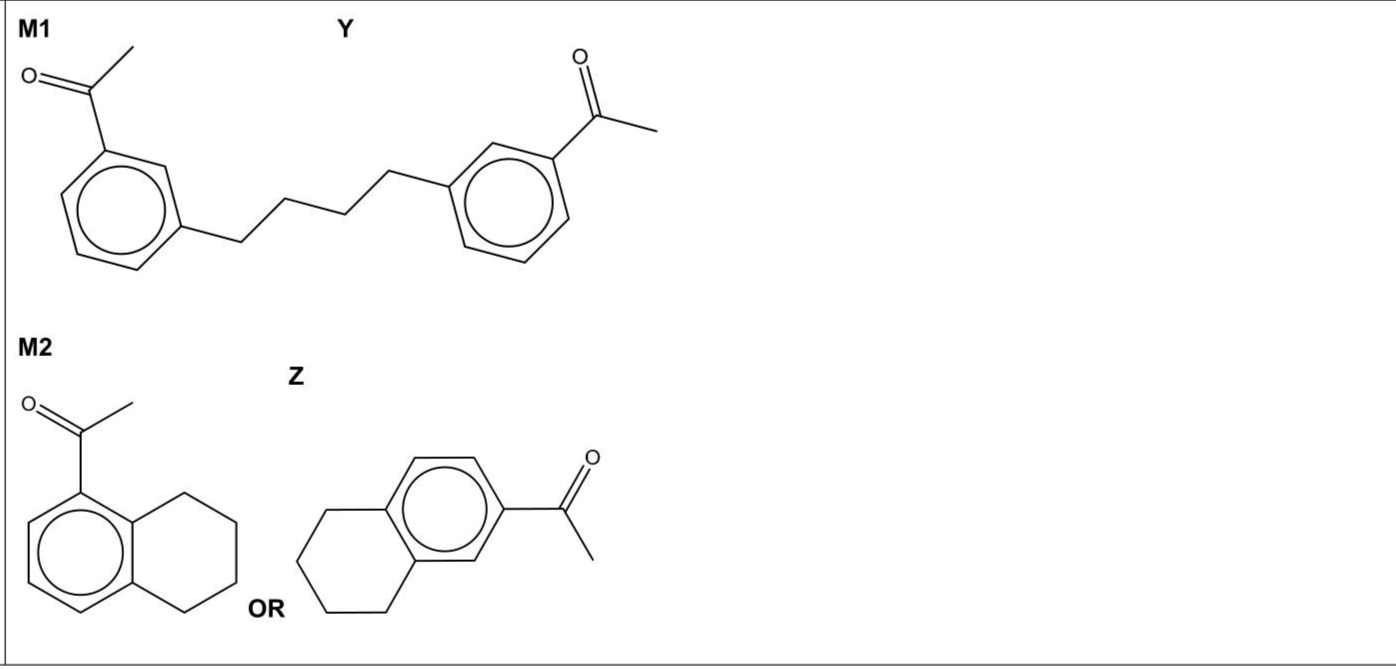
The reaction of phenylethanone with 1,4-dibromobutane, $$\(\mathrm{BrCH}_{2} \mathrm{CH}_{2} \mathrm{CH}_{2} \mathrm{CH}_{2} \mathrm{Br}\)$$, in the presence of $$\(\mathrm{FeBr}_{3}\)$$ is shown in Fig. 6.2. The mechanism of this reaction is similar to that of the alkylation of benzene. (i) Construct an equation for the formation of the electrophile, $$\(\mathrm{BrCH}_{2} \mathrm{CH}_{2} \mathrm{CH}_{2} \mathrm{CH}_{2}{ }^{+}\)$$. ................................................................................................................................. (ii) Complete the mechanism in Fig. 6.3 for the reaction of phenylethanone with $$\(\mathrm{BrCH}_{2} \mathrm{CH}_{2} \mathrm{CH}_{2} \mathrm{CH}_{2}^{+}\)$$ions. Include all relevant curly arrows and charges. Draw the structure of the organic intermediate. (iii) The reaction shown in Fig. 6.2 forms small amounts of two by-products, $$\(\mathbf{Y}\left(\mathrm{C}_{20} \mathrm{H}_{22} \mathrm{O}_{2}\right)\)$$ and $$\(\mathbf{Z}\left(\mathrm{C}_{12} \mathrm{H}_{14} \mathrm{O}\right)\)$$. Suggest structures for $$\(\mathbf{Y}\)$$ and $$\(\mathbf{Z}\)$$ in the boxes in Fig. 6.4.
Exam No:9701_s24_qp_41 Year:2024 Question No:6(f)
Answer:

Knowledge points:
13.4.1 describe structural isomerism and its division into chain, positional and functional group isomerism
13.4.2 describe stereoisomerism and its division into geometrical (cis/trans) and optical isomerism (use of E, Z nomenclature is acceptable but is not required)
13.4.3 describe geometrical (cis/trans) isomerism in alkenes, and explain its origin in terms of restricted rotation due to the presence of π bonds
13.4.4 explain what is meant by a chiral centre and that such a centre gives rise to two optical isomers (enantiomers) (Candidates should appreciate that compounds can contain more than one chiral centre, but knowledge of meso compounds, or nomenclature such as diastereoisomers is not required)
13.4.5 identify chiral centres and geometrical (cis/trans) isomerism in a molecule of given structural formula including cyclic compounds
13.4.6 deduce the possible isomers for an organic molecule of known molecular formula
Solution:
Download APP for more features
1. Tons of answers.
2. Smarter Al tools enhance your learning journey.
IOS
Download
Download
Android
Download
Download
Google Play
Download
Download