
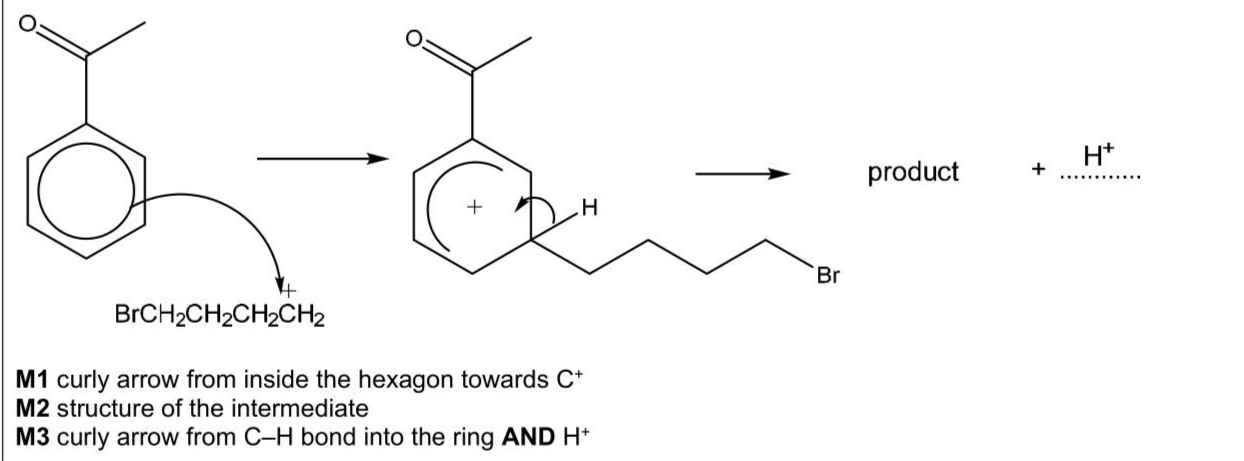
The reaction of phenylethanone with 1,4-dibromobutane, $$\(\mathrm{BrCH}_{2} \mathrm{CH}_{2} \mathrm{CH}_{2} \mathrm{CH}_{2} \mathrm{Br}\)$$, in the presence of $$\(\mathrm{FeBr}_{3}\)$$ is shown in Fig. 6.2. The mechanism of this reaction is similar to that of the alkylation of benzene. (i) Construct an equation for the formation of the electrophile, $$\(\mathrm{BrCH}_{2} \mathrm{CH}_{2} \mathrm{CH}_{2} \mathrm{CH}_{2}{ }^{+}\)$$. ................................................................................................................................. (ii) Complete the mechanism in Fig. 6.3 for the reaction of phenylethanone with $$\(\mathrm{BrCH}_{2} \mathrm{CH}_{2} \mathrm{CH}_{2} \mathrm{CH}_{2}^{+}\)$$ions. Include all relevant curly arrows and charges. Draw the structure of the organic intermediate. (iii) The reaction shown in Fig. 6.2 forms small amounts of two by-products, $$\(\mathbf{Y}\left(\mathrm{C}_{20} \mathrm{H}_{22} \mathrm{O}_{2}\right)\)$$ and $$\(\mathbf{Z}\left(\mathrm{C}_{12} \mathrm{H}_{14} \mathrm{O}\right)\)$$. Suggest structures for $$\(\mathbf{Y}\)$$ and $$\(\mathbf{Z}\)$$ in the boxes in Fig. 6.4.
Exam No:9701_s24_qp_43 Year:2024 Question No:6(f)
Answer:


Knowledge points:
8.1.1 explain and use the term rate of reaction, frequency of collisions, effective collisions and non-effective collisions
8.1.2 explain qualitatively, in terms of frequency of effective collisions, the effect of concentration and pressure changes on the rate of a reaction
8.1.3 use experimental data to calculate the rate of a reaction
Solution:
Download APP for more features
1. Tons of answers.
2. Smarter Al tools enhance your learning journey.
IOS
Download
Download
Android
Download
Download
Google Play
Download
Download