
From 2017 to 2021 public expenditure as a proportion of GDP rose from $$\(25.1 \%\)$$ to $$\(29.5 \%\)$$ in Azerbaijan and from 12.5\% to $$\(15.9 \%\)$$ in India. Evaluate possible causes of an increase in public expenditure as a proportion of GDP in a developing economy of your choice. ................................................................................................................................................................................................................................................................................ ................................................................................................................................................................................................................................................................................
Exam No:wec14-01-que-20240605 Year:2024 Question No:10
Answer:
Indicative content guidance
Answers must be credited by using the level descriptors (below) in line with the general marking guidance. The indicative content below exemplifies some of the points that candidates may make but this does not imply that any of these must be included. Other relevant points must also be credited.
QS9: Interpret, apply and analyse information in written, graphical, tabular and numerical forms.
Knowledge, Application, Analysis (12 marks) - indicative content
- Understanding of public expenditure
Possible causes could include:
- Changes in level of GDP: during periods of economic downturn, public expenditure as a proportion of GDP would increase, even if it stayed the same or declined at a slower rate than GDP
- Automatic stabilisers: when GDP falls, public expenditure is likely to rise; people become eligible for means-tested/unemployment benefits
- External shocks: e.g. global health crisis; natural disasters e.g. earthquakes, floods; subsidies to households and firms resulting from rise in energy prices
- Increased expectations: people may expect higher standards of education or health - these public services may be normal or luxury goods (income elastic)
- Ageing population: it may require greater government spending, e.g. on state pensions, social care etc
- Increase in the size of the population: puts greater pressure on public goods and services e.g. healthcare, education etc
- Discretionary fiscal policy: government may decide to spend more on a specific area, e.g. housing, infrastructure etc
- Increased interest payments: as the national debt increases / interest rates increase, governments have to make higher interest payments on their debt
- Rise in the tax base: reducing tax evasion and avoidance, allowing greater spending as a proportion of GDP
- Political priorities: based on the value judgements of government
N.B. Award maximum of Level 3 ( 9 marks) if a candidate does not refer to a developing country in their answer
Evaluation (8 marks) - indicative content
- Prioritisation of causes analysed - discussion of the most important cause
- Discussion of the magnitude of the increase in public expenditure e.g. 4.4pp for Azerbaijan and 3.4pp for India: relatively small increase
- Significance of the causes vary over time and between countries
- Likely to be a combination of causes that has contributed to the increase
- Changes in the level of GDP would explain short-run changes only - when the economic cycle changes country could face the reverse effect
- Ageing populations may imply that less spending is required for education and healthcare
- Interest payments depend on the interest rate as well as the amount owing
- The level of public expenditure may not be rising if GDP is falling
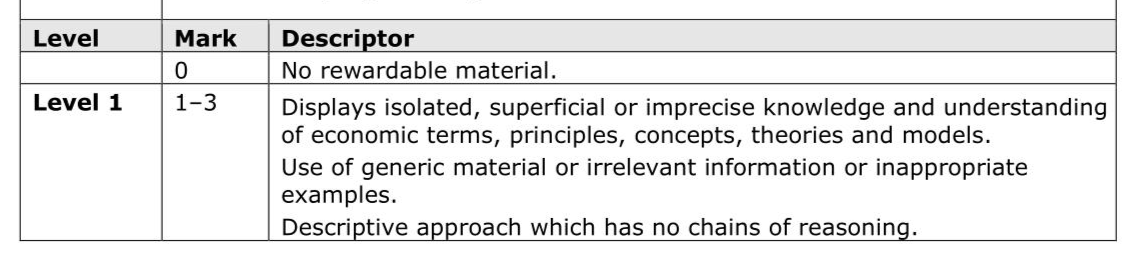
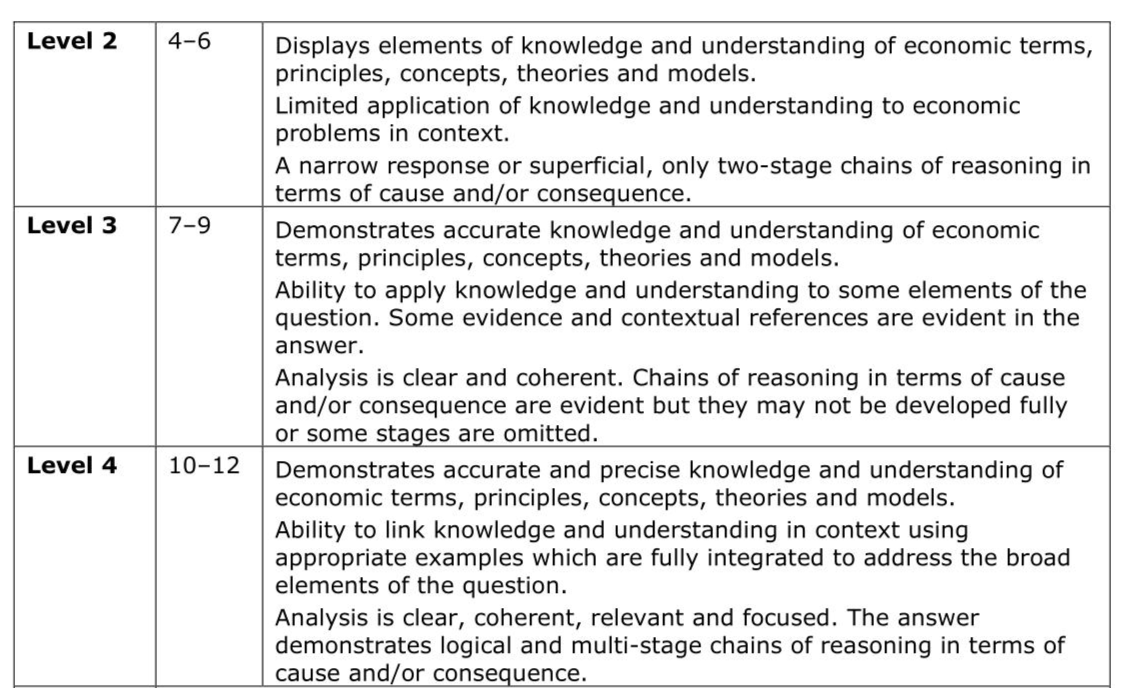
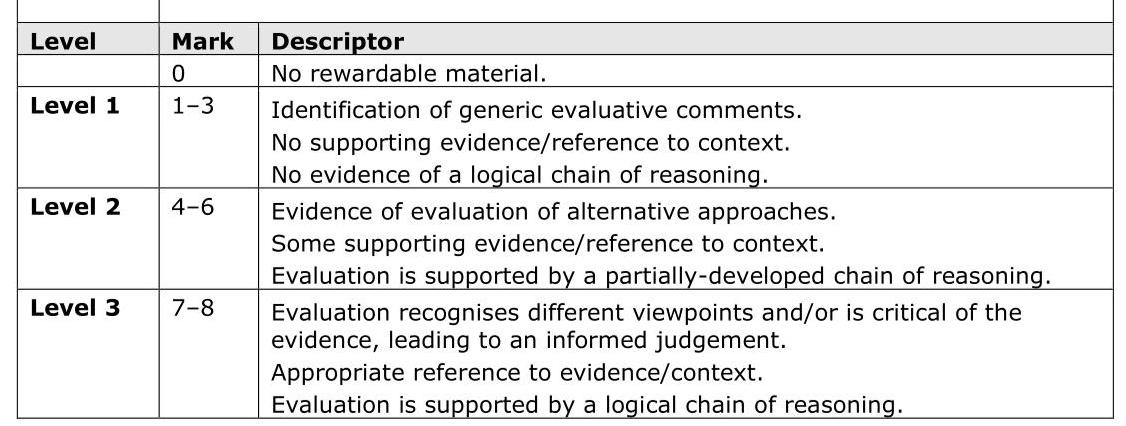
Answers must be credited by using the level descriptors (below) in line with the general marking guidance. The indicative content below exemplifies some of the points that candidates may make but this does not imply that any of these must be included. Other relevant points must also be credited.
QS9: Interpret, apply and analyse information in written, graphical, tabular and numerical forms.
Knowledge, Application, Analysis (12 marks) - indicative content
- Understanding of public expenditure
Possible causes could include:
- Changes in level of GDP: during periods of economic downturn, public expenditure as a proportion of GDP would increase, even if it stayed the same or declined at a slower rate than GDP
- Automatic stabilisers: when GDP falls, public expenditure is likely to rise; people become eligible for means-tested/unemployment benefits
- External shocks: e.g. global health crisis; natural disasters e.g. earthquakes, floods; subsidies to households and firms resulting from rise in energy prices
- Increased expectations: people may expect higher standards of education or health - these public services may be normal or luxury goods (income elastic)
- Ageing population: it may require greater government spending, e.g. on state pensions, social care etc
- Increase in the size of the population: puts greater pressure on public goods and services e.g. healthcare, education etc
- Discretionary fiscal policy: government may decide to spend more on a specific area, e.g. housing, infrastructure etc
- Increased interest payments: as the national debt increases / interest rates increase, governments have to make higher interest payments on their debt
- Rise in the tax base: reducing tax evasion and avoidance, allowing greater spending as a proportion of GDP
- Political priorities: based on the value judgements of government
N.B. Award maximum of Level 3 ( 9 marks) if a candidate does not refer to a developing country in their answer
Evaluation (8 marks) - indicative content
- Prioritisation of causes analysed - discussion of the most important cause
- Discussion of the magnitude of the increase in public expenditure e.g. 4.4pp for Azerbaijan and 3.4pp for India: relatively small increase
- Significance of the causes vary over time and between countries
- Likely to be a combination of causes that has contributed to the increase
- Changes in the level of GDP would explain short-run changes only - when the economic cycle changes country could face the reverse effect
- Ageing populations may imply that less spending is required for education and healthcare
- Interest payments depend on the interest rate as well as the amount owing
- The level of public expenditure may not be rising if GDP is falling
Knowledge points:
22.The role of the state in the macroeconomy
Solution:
Download APP for more features
1. Tons of answers.
2. Smarter Al tools enhance your learning journey.
IOS
Download
Download
Android
Download
Download
Google Play
Download
Download