
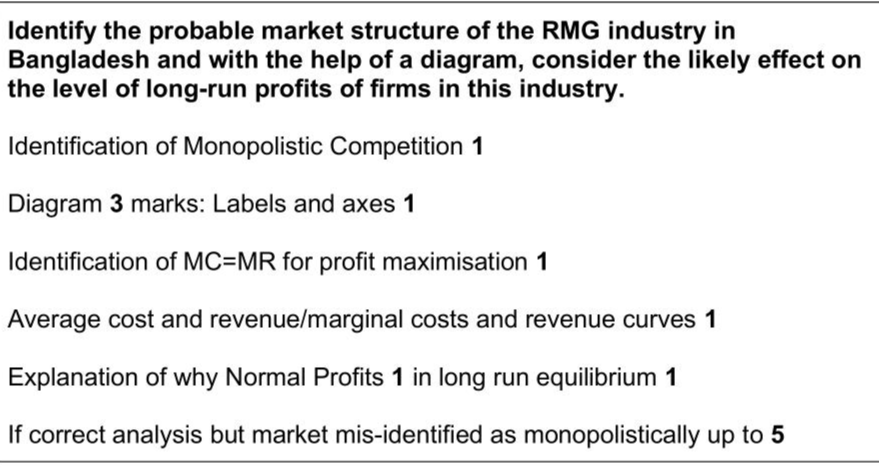
Since 1971 Bangladesh has experienced significant economic development, moving from the low-income to the lower-middle-income country classification. Gross National Income (GNI) per capita at constant 2017 prices in United States dollars (\$) rose from \$2342 to \$5823 between 2000 and 2020. Over the same period, the country's Human Development Index (HDI) rose from 0.49 to 0.66 . During this period, Bangladesh underwent changes in employment as it moved from the agricultural sector to the manufacturing and services sectors. First, in agriculture, output increased by more than $$\(100 \%\)$$ whilst employment fell from $$\(65 \%\)$$ to $$\(38 \%\)$$ of the working population. This change was helped by innovation in crop irrigation, land preparation and harvesting, aided by the development of local industries to provide the capital equipment needed. A second source of economic development was the growth in the clothing industry producing ready-made garments (RMG) that contributed about $$\(11 \%\)$$ of Bangladesh's Gross Domestic Product (GDP) and employed 4.4 million workers of which 2.5 million were women (2020). The industry uses significant division of labour with production split into 10 or more processes, for example, cutting, sewing zips, assembly and packaging. The value of raw materials imported for the RMG industry was about half of the value of the industry's exports. Net exports from this sector stood at $$\(\$ 23\)$$ billion. This enabled Bangladesh to both import a wider range of goods and services and reduce the deficit on its balance of trade in goods. In 2020, there were more than 4000 RMG manufacturers in Bangladesh, differentiated by the quality of their products and the speed of their delivery. The RMG industry supplied more than 100 major US and European retailers. However, the RMG industry has critics who point to air and water pollution from the chemicals used in cotton growing and manufacturing clothes. The industry is also accused of employing child labour and of having poorly constructed factories. Sources: Bangladesh overview: World Bank, 11 April 2024 and Quarterly Review on Readymade Garments, Bangladesh Bank Research Department, 14 February 2023 Identify the probable market structure of the RMG industry in Bangladesh and with the help of a diagram, consider the likely effect on the level of long-run profits of firms in this industry.
Exam No:9708_s25_qp_44 Year:2025 Question No:1(c)
Answer:
Knowledge points:
7.5.10 calculation of supernormal and subnormal profit
7.5.9 definition of normal, subnormal and supernormal profit
7.6.1 perfect competition and imperfect competition: monopoly, monopolistic competition, oligopoly, natural monopoly
7.6.2 structure of the listed markets as explained by number of buyers and sellers, product differentiation, degree of freedom of entry and availability of information
Solution:
Download APP for more features
1. Tons of answers.
2. Smarter Al tools enhance your learning journey.
IOS
Download
Download
Android
Download
Download
Google Play
Download
Download