
HYT is a travel business which sells holidays. One of its objectives is growth. Last year HYT completed a takeover of one of its competitors. External sources of finance were used to fund this growth. HYT now has 460 shops and 4000 employees. The Human Resources Director knows there are benefits and limitations for a business of having full-time employees. HYT's managers use ideas from Herzberg's motivational theory to keep employees motivated. Good internal communication is important for HYT. (e)Do you think the benefits to a business of having full-time employees are greater than the limitations?Justify your answer. .......................................................................................................................................
Exam No:0450_s25_qp_13 Year:2025 Question No:4(e)
Answer:
Award up to 2 marks for identification of relevant points. Award up to 2 marks for relevant development of points. Award up to 2 marks for a justified decision as to whether the benefits of having full-time employees for a business are greater than the limitations.
Points might include:
Benefits:
- More familiar with business / consistent service / quality [k] which helps build / maintain customer relationships / better reputation / more productive [an]
- Workers likely to be loyal / committed / less likely to leave [k] reducing (recruitment) costs [an]
- Easy to communicate / update [k] leading to fewer errors [an]
- Fewer employees to train / recruit [k] saving time / cost [an]
Limitations:
- May not be willing / want to increase hours / not want to work overtime [k] so may be difficult to meet demand [an]
- Must pay whether (sufficient) work for them to do or not [k] increasing labour costs [an]
- May miss out on potential employees who cannot work full-time [k]
Other appropriate responses should be credited.
Justification might include:
Full-time employees can provide a consistent service [k] which helps maintain customer relationships [an]. However, they may not be willing to increase hours \([\mathrm{k}]\) so it may be difficult to meet demand [an]. The benefits are greater because maintaining customer relationships is more likely to lead to additional sales even if they must wait slightly longer to receive the goods [eval] [eval].
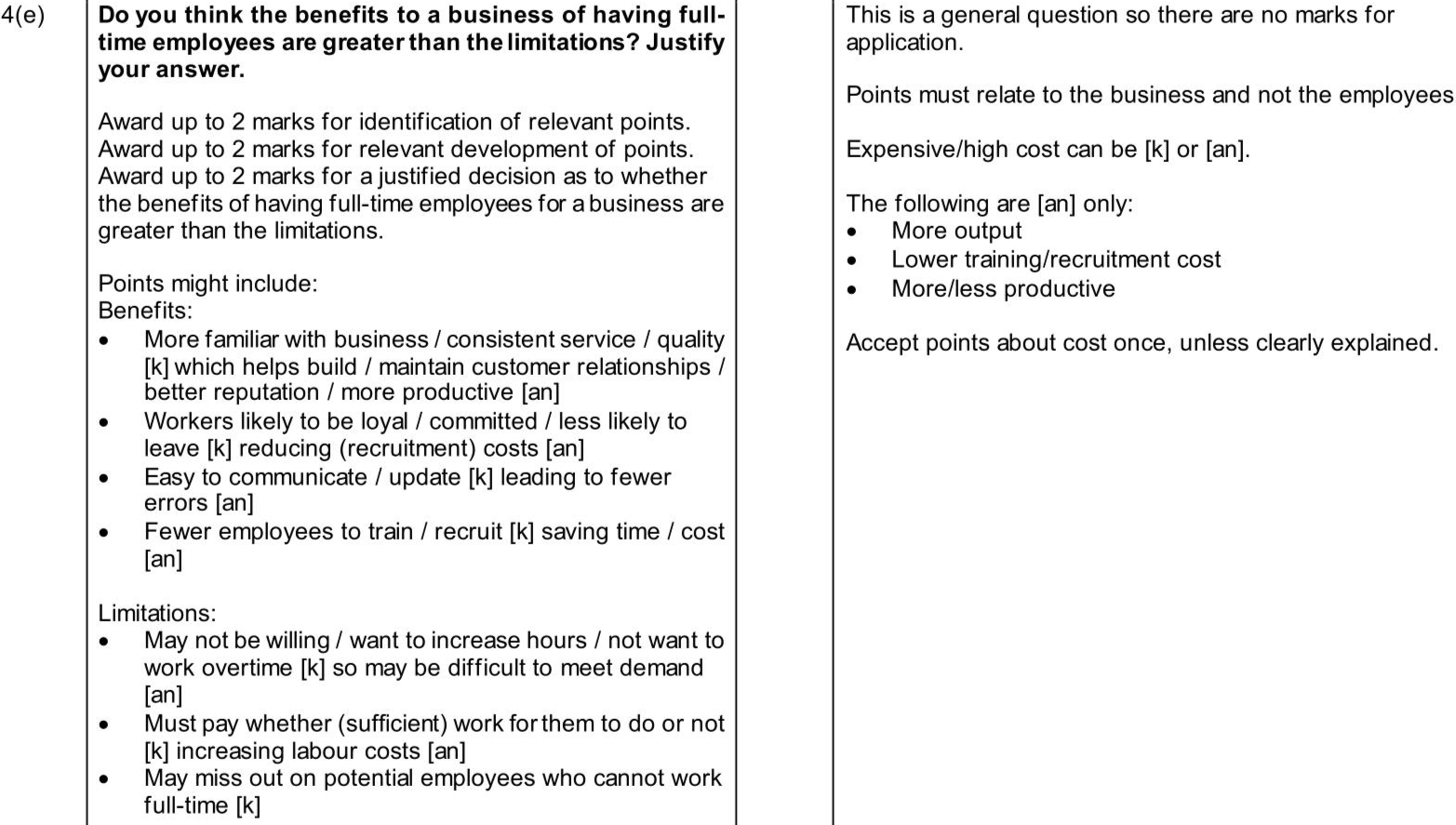
Points might include:
Benefits:
- More familiar with business / consistent service / quality [k] which helps build / maintain customer relationships / better reputation / more productive [an]
- Workers likely to be loyal / committed / less likely to leave [k] reducing (recruitment) costs [an]
- Easy to communicate / update [k] leading to fewer errors [an]
- Fewer employees to train / recruit [k] saving time / cost [an]
Limitations:
- May not be willing / want to increase hours / not want to work overtime [k] so may be difficult to meet demand [an]
- Must pay whether (sufficient) work for them to do or not [k] increasing labour costs [an]
- May miss out on potential employees who cannot work full-time [k]
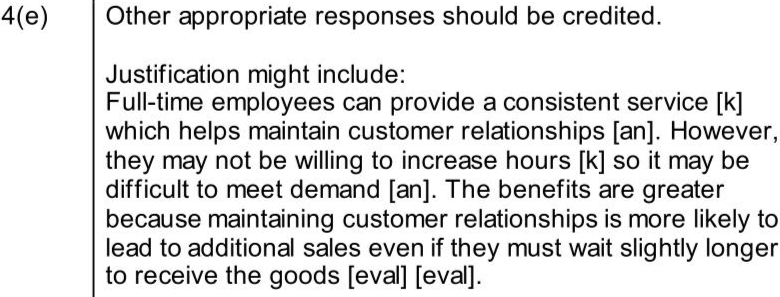
Other appropriate responses should be credited.
Justification might include:
Full-time employees can provide a consistent service [k] which helps maintain customer relationships [an]. However, they may not be willing to increase hours \([\mathrm{k}]\) so it may be difficult to meet demand [an]. The benefits are greater because maintaining customer relationships is more likely to lead to additional sales even if they must wait slightly longer to receive the goods [eval] [eval].
Knowledge points:
2.3.1.1. Recruitment and selection methods
2.3.1.2. Difference between internal recruitment and external recruitment
2.3.1.3. Main stages in recruitment and selection of employees
2.3.1.4. Recommend and justify who to employ in given circumstances
2.3.1.5. Benefits and limitations of part-time employees and full-time employees
2.3.2.1. Importance of training to a business and to employees
2.3.2.2. Benefits and limitations of induction training, on-the-job training and off-the-job training
2.3.3.1. Difference between dismissal and redundancy with examples
2.3.3.2. Understand situations in which downsizing the workforce might be necessary, e.g. automation or reduced demand for products
2.3.3.3. Recommend and justify which employees to make redundant in given circumstances
2.3.4.1. Legal controls over employment contracts, unfair dismissal, discrimination, health and safety, legal minimum wage
Solution:
Download APP for more features
1. Tons of answers.
2. Smarter Al tools enhance your learning journey.
IOS
Download
Download
Android
Download
Download
Google Play
Download
Download