
Jonathon is a sole trader. He owns a shop selling office equipment including printers. To encourage sales Jonathon allows customers 4 weeks to pay for the office equipment. Jonathon thinks his business is likely to remain small. He knows managing cash flow is important for his business and he has prepared a cash flow forecast. An extract is shown in Table 2.1. Do you think the advantages of operating as a sole trader business are greater than the disadvantages? Justify your answer. .......................................................................................................................................
Exam No:0450_s25_qp_13 Year:2025 Question No:2(e)
Answer:
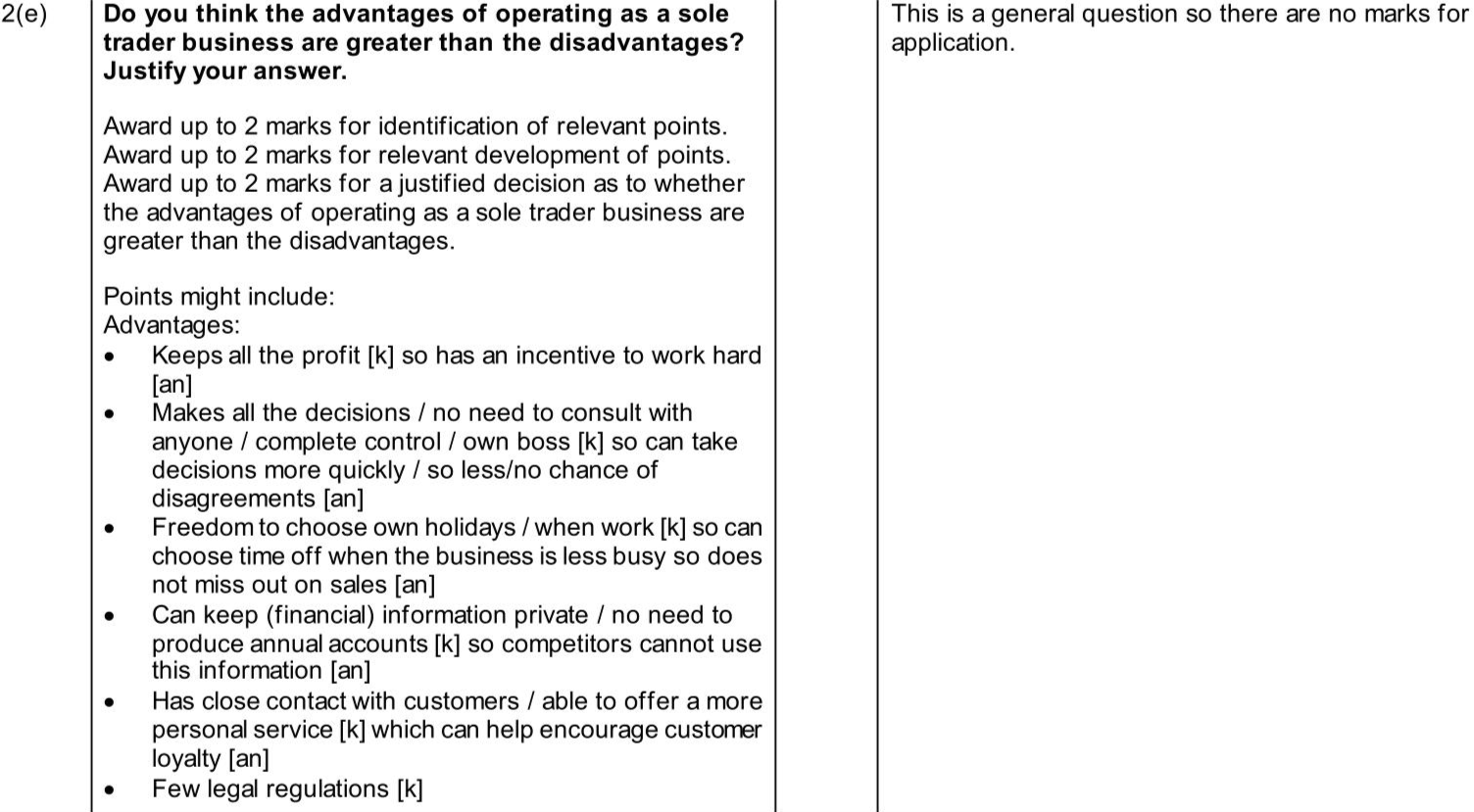
Award up to 2 marks for identification of relevant points. Award up to 2 marks for relevant development of points. Award up to 2 marks for a justified decision as to whether the advantages of operating as a sole trader business are greater than the disadvantages.
Points might include:
Advantages:
- Keeps all the profit [k] so has an incentive to work hard [an]
- Makes all the decisions / no need to consult with anyone / complete control / own boss [k] so can take decisions more quickly / so less/no chance of disagreements [an]
- Freedom to choose own holidays / when work [k] so can choose time off when the business is less busy so does not miss out on sales [an]
- Can keep (financial) information private / no need to produce annual accounts [k] so competitors cannot use this information [an]
- Has close contact with customers / able to offer a more personal service \([\mathrm{k}]\) which can help encourage customer loyalty [an]
- Few legal regulations [k]
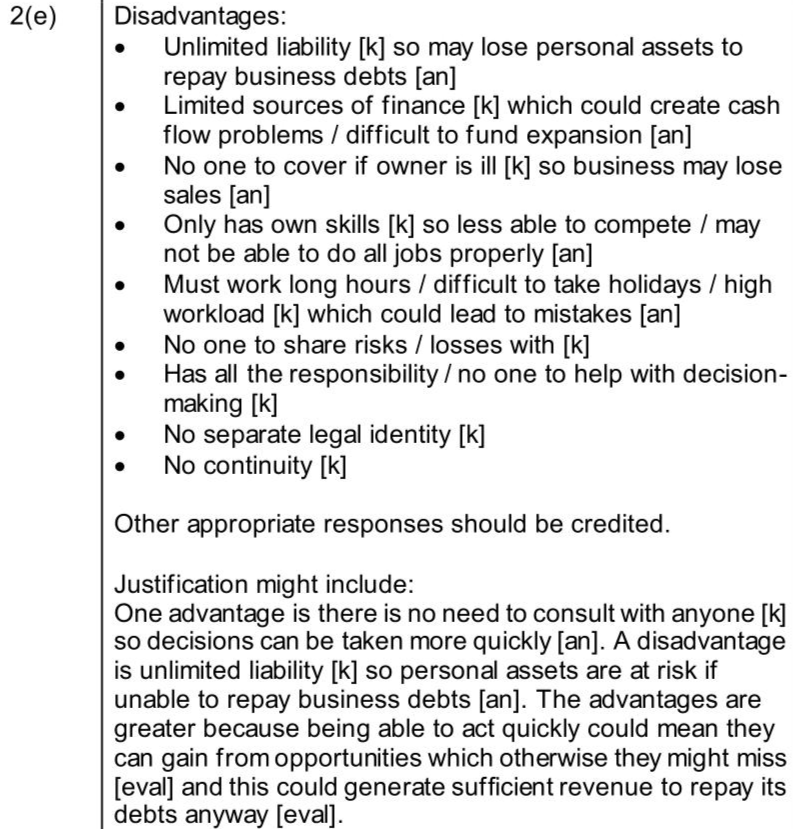
Disadvantages:
- Unlimited liability [k] so may lose personal assets to repay business debts [an]
- Limited sources of finance [k] which could create cash flow problems / difficult to fund expansion [an]
- No one to cover if owner is ill [k] so business may lose sales [an]
- Only has own skills [k] so less able to compete / may not be able to do all jobs properly [an]
- Must work long hours / difficult to take holidays / high workload [k] which could lead to mistakes [an]
- No one to share risks / losses with [k]
- Has all the responsibility / no one to help with decisionmaking [k]
- No separate legal identity [k]
- No continuity [k]
Other appropriate responses should be credited.
Justification might include:
One advantage is there is no need to consult with anyone [k] so decisions can be taken more quickly [an]. A disadvantage is unlimited liability [k] so personal assets are at risk if unable to repay business debts [an]. The advantages are greater because being able to act quickly could mean they can gain from opportunities which otherwise they might miss [eval] and this could generate sufficient revenue to repay its debts anyway [eval].
Points might include:
Advantages:
- Keeps all the profit [k] so has an incentive to work hard [an]
- Makes all the decisions / no need to consult with anyone / complete control / own boss [k] so can take decisions more quickly / so less/no chance of disagreements [an]
- Freedom to choose own holidays / when work [k] so can choose time off when the business is less busy so does not miss out on sales [an]
- Can keep (financial) information private / no need to produce annual accounts [k] so competitors cannot use this information [an]
- Has close contact with customers / able to offer a more personal service \([\mathrm{k}]\) which can help encourage customer loyalty [an]
- Few legal regulations [k]
Disadvantages:
- Unlimited liability [k] so may lose personal assets to repay business debts [an]
- Limited sources of finance [k] which could create cash flow problems / difficult to fund expansion [an]
- No one to cover if owner is ill [k] so business may lose sales [an]
- Only has own skills [k] so less able to compete / may not be able to do all jobs properly [an]
- Must work long hours / difficult to take holidays / high workload [k] which could lead to mistakes [an]
- No one to share risks / losses with [k]
- Has all the responsibility / no one to help with decisionmaking [k]
- No separate legal identity [k]
- No continuity [k]
Other appropriate responses should be credited.
Justification might include:
One advantage is there is no need to consult with anyone [k] so decisions can be taken more quickly [an]. A disadvantage is unlimited liability [k] so personal assets are at risk if unable to repay business debts [an]. The advantages are greater because being able to act quickly could mean they can gain from opportunities which otherwise they might miss [eval] and this could generate sufficient revenue to repay its debts anyway [eval].
Knowledge points:
1.4.1.1. Sole traders, partnerships, private and public limited companies, franchises and joint ventures
1.4.1.2. Differences between unincorporated businesses and limited companies
1.4.1.3. Concepts of risk, ownership and limited liability
1.4.1.4. Recommend and justify a suitable form of business organisation to owners/management in a given situation
1.4.1.5. Business organisations in the public sector, e.g. public corporations
Solution:
Download APP for more features
1. Tons of answers.
2. Smarter Al tools enhance your learning journey.
IOS
Download
Download
Android
Download
Download
Google Play
Download
Download