
MDZ manufactures a range of chocolate bars. It has 300 employees. MDZ purchases its ingredients from suppliers in the local area. Acting in an ethical way with its stakeholder groups is important. MDZ has products at different stages of the product life cycle. The business is also developing a new product. The Marketing Director needs to make decisions about the packaging and the price of the new product. She knows it is important for a business to use a suitable method of sales promotion for a new product. Explain one way MDZ could act in an ethical way with each of the following stakeholder groups: Employees: Explanation: Suppliers: Explanation: .......................................................................................................................................
Exam No:0450_s25_qp_13 Year:2025 Question No:1(d)
Answer:
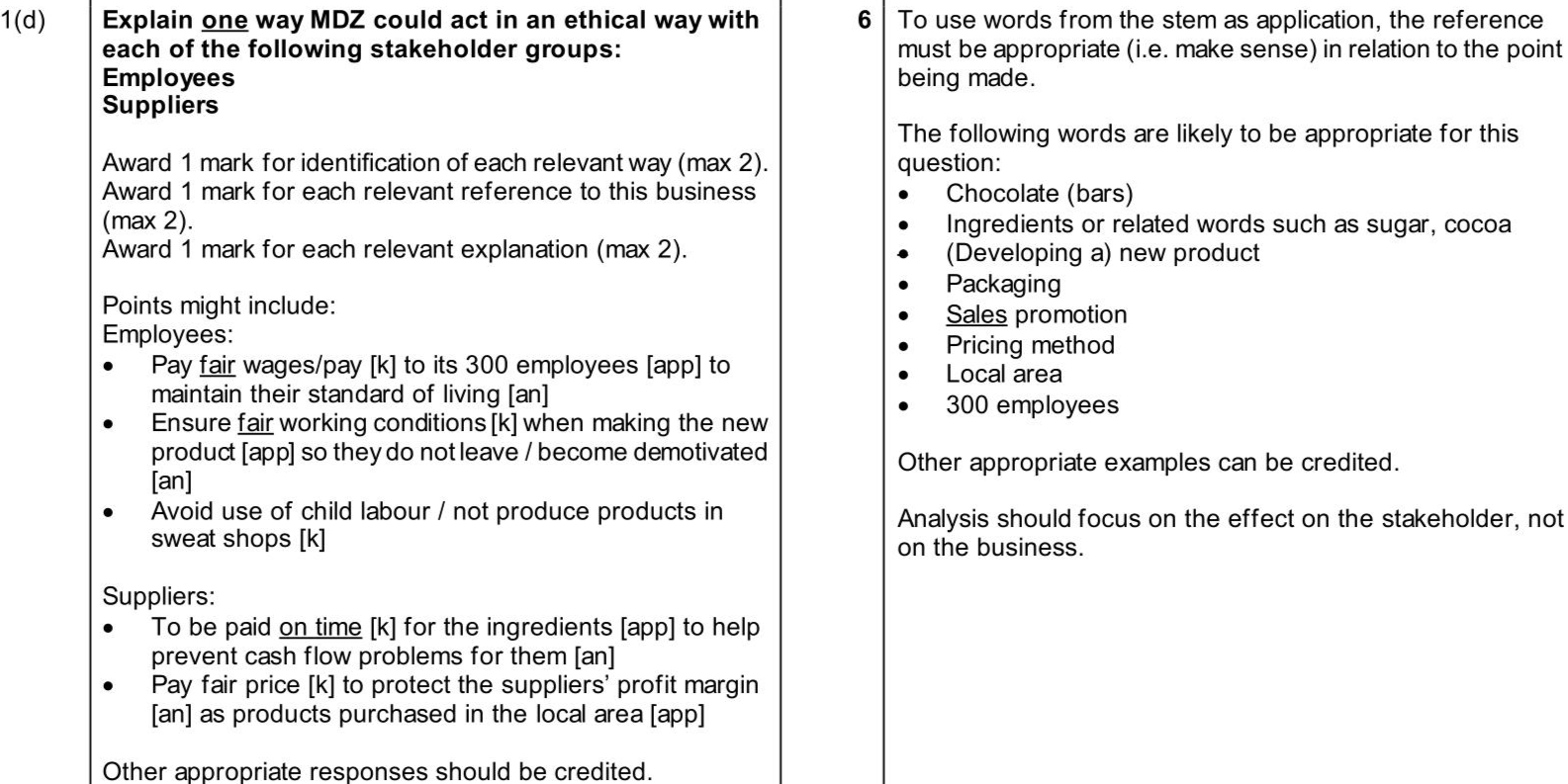
Award 1 mark for identification of each relevant way (max 2 ). Award 1 mark for each relevant reference to this business (max 2).
Award 1 mark for each relevant explanation (max 2).
Points might include:
Employees:
- Pay fair wages/pay [k] to its 300 employees [app] to maintain their standard of living [an]
- Ensure fair working conditions [k] when making the new product [app] so they do not leave / become demotivated [an]
- Avoid use of child labour / not produce products in sweat shops [k]
Suppliers:
- To be paid on time [k] for the ingredients [app] to help prevent cash flow problems for them [an]
- Pay fair price [k] to protect the suppliers' profit margin [an] as products purchased in the local area [app]
Other appropriate responses should be credited.
Award 1 mark for each relevant explanation (max 2).
Points might include:
Employees:
- Pay fair wages/pay [k] to its 300 employees [app] to maintain their standard of living [an]
- Ensure fair working conditions [k] when making the new product [app] so they do not leave / become demotivated [an]
- Avoid use of child labour / not produce products in sweat shops [k]
Suppliers:
- To be paid on time [k] for the ingredients [app] to help prevent cash flow problems for them [an]
- Pay fair price [k] to protect the suppliers' profit margin [an] as products purchased in the local area [app]
Other appropriate responses should be credited.
Knowledge points:
1.5.1.1. Need for business objectives and the importance of them
1.5.1.2. Different business objectives, e.g. survival, growth, profit and market share
1.5.1.3. Objectives of social enterprises
1.5.2.1. Main internal and external stakeholder groups
1.5.2.2. Objectives of different stakeholder groups
1.5.2.3. How these objectives might conflict with each other, use examples
1.5.3. Differences in the objectives of private sector and public sector enterprises
6.2.1.1. How business activity can impact on the environment, e.g. global warming
6.2.1.2. The concept of externalities: possible external costs and external benefits of business decisions
6.2.1.3. Sustainable development; how business activity can contribute to this
6.2.1.4. How and why business might respond to environmental pressures and opportunities, e.g. pressure groups
6.2.1.5. The role of legal controls over business activity affecting the environment, e.g. pollution controls
6.2.1.6. Ethical issues a business might face: conflicts between profits and ethics
6.2.1.7. How business might react and respond to ethical issues, e.g. child labour, paying fair prices to suppliers
Solution:
Download APP for more features
1. Tons of answers.
2. Smarter Al tools enhance your learning journey.
IOS
Download
Download
Android
Download
Download
Google Play
Download
Download