
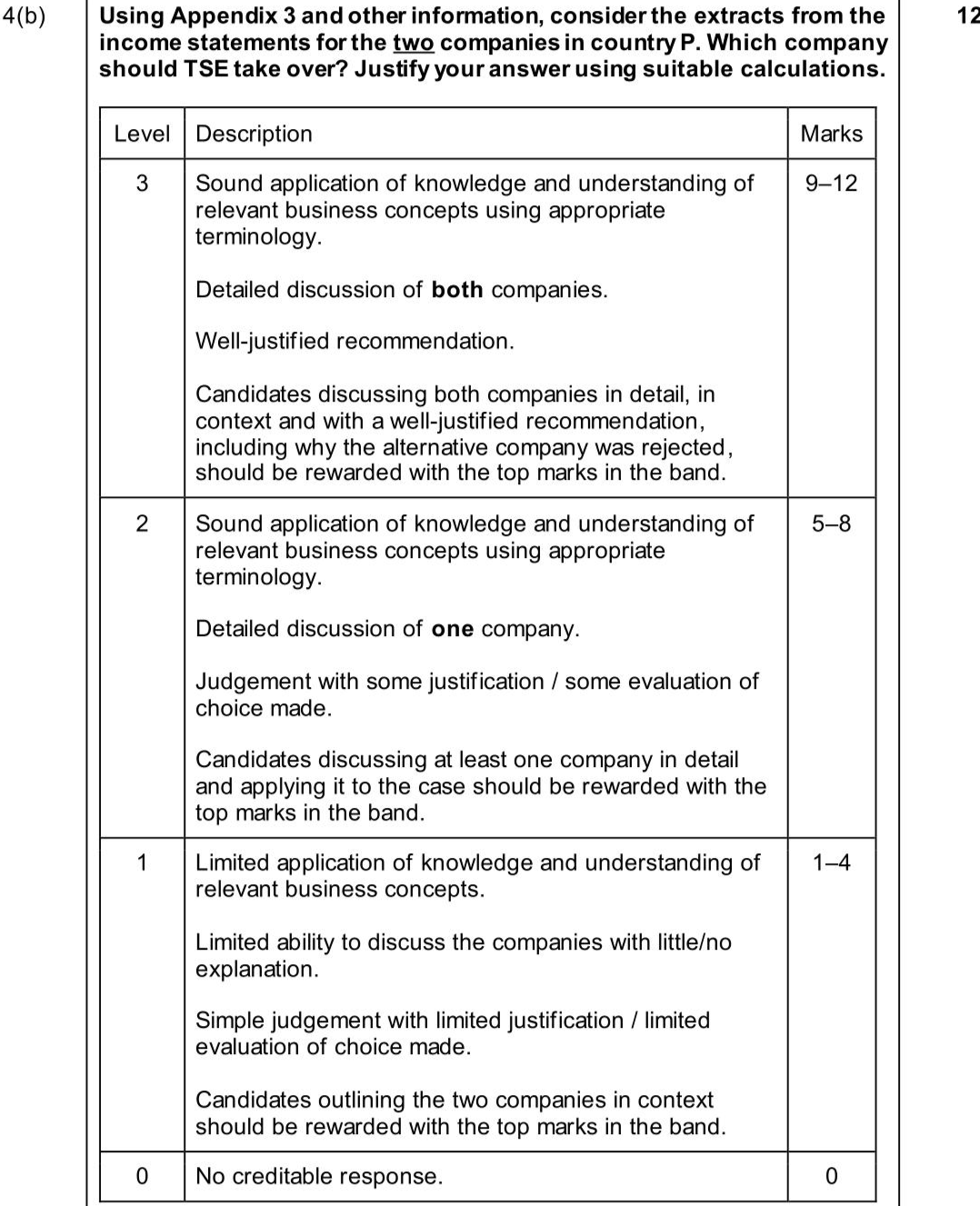
Using Appendix 3 and other information, consider the extracts from the income statements for the two companies in country P. Which company should TSE take over? Justify your answer using suitable calculations. Company A: . . . . . . . Company B: . . . . . . . Recommendation: . . . . . . .
Exam No:0450_s25_qp_22 Year:2025 Question No:4(b)
Answer:
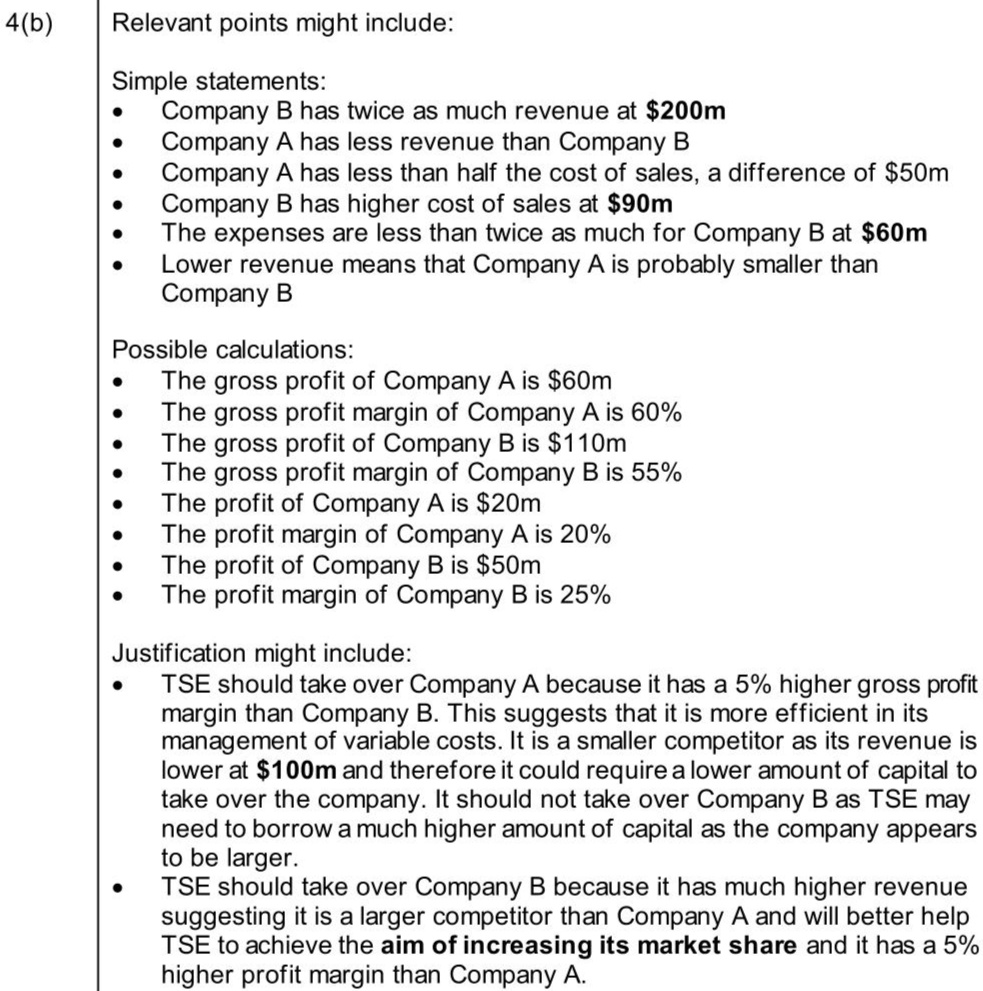
Relevant points might include:
Simple statements:
- Company B has twice as much revenue at \$200m
- Company A has less revenue than Company B
- Company A has less than half the cost of sales, a difference of \(\$ 50 \mathrm{~m}\)
- Company B has higher cost of sales at \(\$ 90 \mathrm{~m}\)
- The expenses are less than twice as much for Company B at \$60m
- Lower revenue means that Company A is probably smaller than Company B
Possible calculations:
- The gross profit of Company A is \(\$ 60 \mathrm{~m}\)
- The gross profit margin of Company A is \(60 \%\)
- The gross profit of Company \(B\) is \(\$ 110 \mathrm{~m}\)
- The gross profit margin of Company \(B\) is \(55 \%\)
- The profit of Company A is \(\$ 20 \mathrm{~m}\)
- The profit margin of Company A is \(20 \%\)
- The profit of Company B is \(\$ 50 \mathrm{~m}\)
- The profit margin of Company B is \(25 \%\)
Justification might include:
- TSE should take over Company A because it has a \(5 \%\) higher gross profit margin than Company B. This suggests that it is more efficient in its management of variable costs. It is a smaller competitor as its revenue is lower at \$100m and therefore it could require a lower amount of capital to take over the company. It should not take over Company B as TSE may need to borrow a much higher amount of capital as the company appears to be larger.
- TSE should take over Company B because it has much higher revenue suggesting it is a larger competitor than Company A and will better help TSE to achieve the aim of increasing its market share and it has a \(5 \%\) higher profit margin than Company A.
Simple statements:
- Company B has twice as much revenue at \$200m
- Company A has less revenue than Company B
- Company A has less than half the cost of sales, a difference of \(\$ 50 \mathrm{~m}\)
- Company B has higher cost of sales at \(\$ 90 \mathrm{~m}\)
- The expenses are less than twice as much for Company B at \$60m
- Lower revenue means that Company A is probably smaller than Company B
Possible calculations:
- The gross profit of Company A is \(\$ 60 \mathrm{~m}\)
- The gross profit margin of Company A is \(60 \%\)
- The gross profit of Company \(B\) is \(\$ 110 \mathrm{~m}\)
- The gross profit margin of Company \(B\) is \(55 \%\)
- The profit of Company A is \(\$ 20 \mathrm{~m}\)
- The profit margin of Company A is \(20 \%\)
- The profit of Company B is \(\$ 50 \mathrm{~m}\)
- The profit margin of Company B is \(25 \%\)
Justification might include:
- TSE should take over Company A because it has a \(5 \%\) higher gross profit margin than Company B. This suggests that it is more efficient in its management of variable costs. It is a smaller competitor as its revenue is lower at \$100m and therefore it could require a lower amount of capital to take over the company. It should not take over Company B as TSE may need to borrow a much higher amount of capital as the company appears to be larger.
- TSE should take over Company B because it has much higher revenue suggesting it is a larger competitor than Company A and will better help TSE to achieve the aim of increasing its market share and it has a \(5 \%\) higher profit margin than Company A.
Knowledge points:
5.3.1.1. How a profit is made
5.3.1.2. Importance of profit to private sector businesses, e.g. reward for risk-taking/enterprise, source of finance
5.3.1.3. Difference between profit and cash
5.3.2.1. Main features of an income statement, e.g. revenue, cost of sales, gross profit, profit and retained profit
5.3.2.2. Use simple income statements in decision- making based on profit calculations (constructing income statements will not be assessed)
5.5.1.1. The concept and importance of profitability
5.5.2.1. The concept and importance of liquidity
5.5.3.1. Gross profit margin
5.5.3.2. Profit margin
5.5.3.3. Return on Capital Employed
5.5.3.4. Current ratio
5.5.3.5. Acid test ratio
5.5.4.1. Needs of different users of accounts and ratio analysis
5.5.4.2. How users of accounts and ratio results might use information to help make decisions, e.g. whether to lend to or invest in the business
Solution:
Download APP for more features
1. Tons of answers.
2. Smarter Al tools enhance your learning journey.
IOS
Download
Download
Android
Download
Download
Google Play
Download
Download