
(a)Explain one advantage and one disadvantage of PF selling its products in a mass market. Advantage: . Explanation: . . . . . Disadvantage: . Explanation: . . . . .
Exam No:0450_s25_qp_21 Year:2025 Question No:2(a)
Answer:
Award 1 mark for each advantage/disadvantage of selling in a mass market (max 2).
Award a maximum of 3 additional marks for each explanation of the advantage/disadvantage of selling in a mass market - one of which must be applied to this context.
Relevant advantages might include:
- Total sales in the market may be very high - giving the potential for high revenue - possibly leading to high profits if costs are kept under control
- May be able to benefit from economies of scale - as production is on a large scale and so may benefit from purchasing economies - leading to lower costs per unit / lower average costs
- Risks are spread if several variations of the mass market product are produced - less likely to be affected by changes in consumer spending habits - so sales and revenue remain high even if the sales of one product fall
- Opportunities for the business to grow as high sales/large customer base/high demand
- Can produce a standardised product - production costs are lower than if many variations of the product are produced
Relevant disadvantages might include:
- Likely to be high levels of competition between businesses selling similar products - may need to reduce prices to remain competitive / reduce costs - may lead to lower profit margins
- High costs of advertising and promotion - as need to attract a much wider market to see the adverts such as on TV - so advertise using many and varied types of promotion to ensure the product is seen
- The products are standardised so unlikely to meet the specific needs of all customers or potential customers - so some potential customers may not purchase the product - leading to a loss of potential sales
- May reduce opportunities if consumers are demanding more variety in the products they buy - preferring niche market products - so may lose out to sales from many smaller competitors
For example: Total sales to the market may be very high (1) which is likely to give the potential for high revenue (1) from the high sales of shoes (app). Possibly leading to high profits if costs are kept under control (1).
Application might include: rubber shoes; natural rubber raw material; building a new factory; rubber is grown locally; increase in taxes; bank loan for new factory; sister wants to invest in the business; \$100 000; operates in a very competitive market; started 10 years ago; information from Appendix 3.
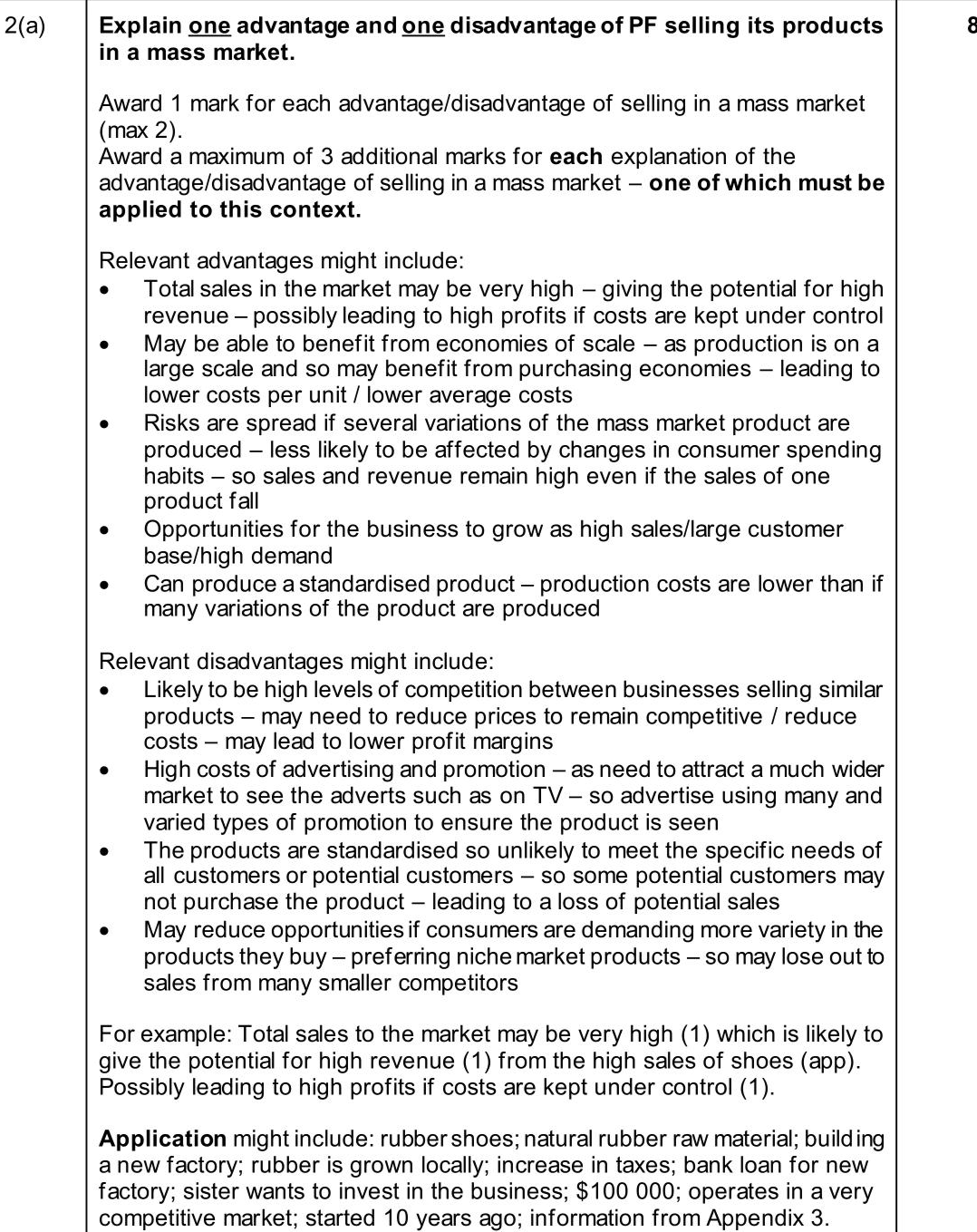
Award a maximum of 3 additional marks for each explanation of the advantage/disadvantage of selling in a mass market - one of which must be applied to this context.
Relevant advantages might include:
- Total sales in the market may be very high - giving the potential for high revenue - possibly leading to high profits if costs are kept under control
- May be able to benefit from economies of scale - as production is on a large scale and so may benefit from purchasing economies - leading to lower costs per unit / lower average costs
- Risks are spread if several variations of the mass market product are produced - less likely to be affected by changes in consumer spending habits - so sales and revenue remain high even if the sales of one product fall
- Opportunities for the business to grow as high sales/large customer base/high demand
- Can produce a standardised product - production costs are lower than if many variations of the product are produced
Relevant disadvantages might include:
- Likely to be high levels of competition between businesses selling similar products - may need to reduce prices to remain competitive / reduce costs - may lead to lower profit margins
- High costs of advertising and promotion - as need to attract a much wider market to see the adverts such as on TV - so advertise using many and varied types of promotion to ensure the product is seen
- The products are standardised so unlikely to meet the specific needs of all customers or potential customers - so some potential customers may not purchase the product - leading to a loss of potential sales
- May reduce opportunities if consumers are demanding more variety in the products they buy - preferring niche market products - so may lose out to sales from many smaller competitors
For example: Total sales to the market may be very high (1) which is likely to give the potential for high revenue (1) from the high sales of shoes (app). Possibly leading to high profits if costs are kept under control (1).
Application might include: rubber shoes; natural rubber raw material; building a new factory; rubber is grown locally; increase in taxes; bank loan for new factory; sister wants to invest in the business; \$100 000; operates in a very competitive market; started 10 years ago; information from Appendix 3.
Knowledge points:
3.1.1.1. Identifying customer needs
3.1.1.2. Satisfying customer needs
3.1.1.3. Maintaining customer loyalty
3.1.1.4. Building customer relationships
3.1.2.1. Why customer/consumer spending patterns may change
3.1.2.2. The importance of changing customer needs
3.1.2.3. Why some markets have become more competitive
3.1.2.4. How businesses can respond to changing spending patterns and increased competition
3.1.3.1. Benefits and limitations of both approaches to marketing
3.1.4.1. How markets can be segmented, e.g. according to age, socio-economic grouping, location, gender
3.1.4.2. Potential benefits of segmentation to business
3.1.4.3. Recommend and justify an appropriate method of segmentation in given circumstances
Solution:
Download APP for more features
1. Tons of answers.
2. Smarter Al tools enhance your learning journey.
IOS
Download
Download
Android
Download
Download
Google Play
Download
Download