
(a)Explain two advantages and two disadvantages to Philip of changing PF from a sole trader business to a private limited company. Advantage 1: . . . Advantage 2: . . . Disadvantage 1: . . . Disadvantage 2: . . .
Exam No:0450_s25_qp_21 Year:2025 Question No:1(a)
Answer:
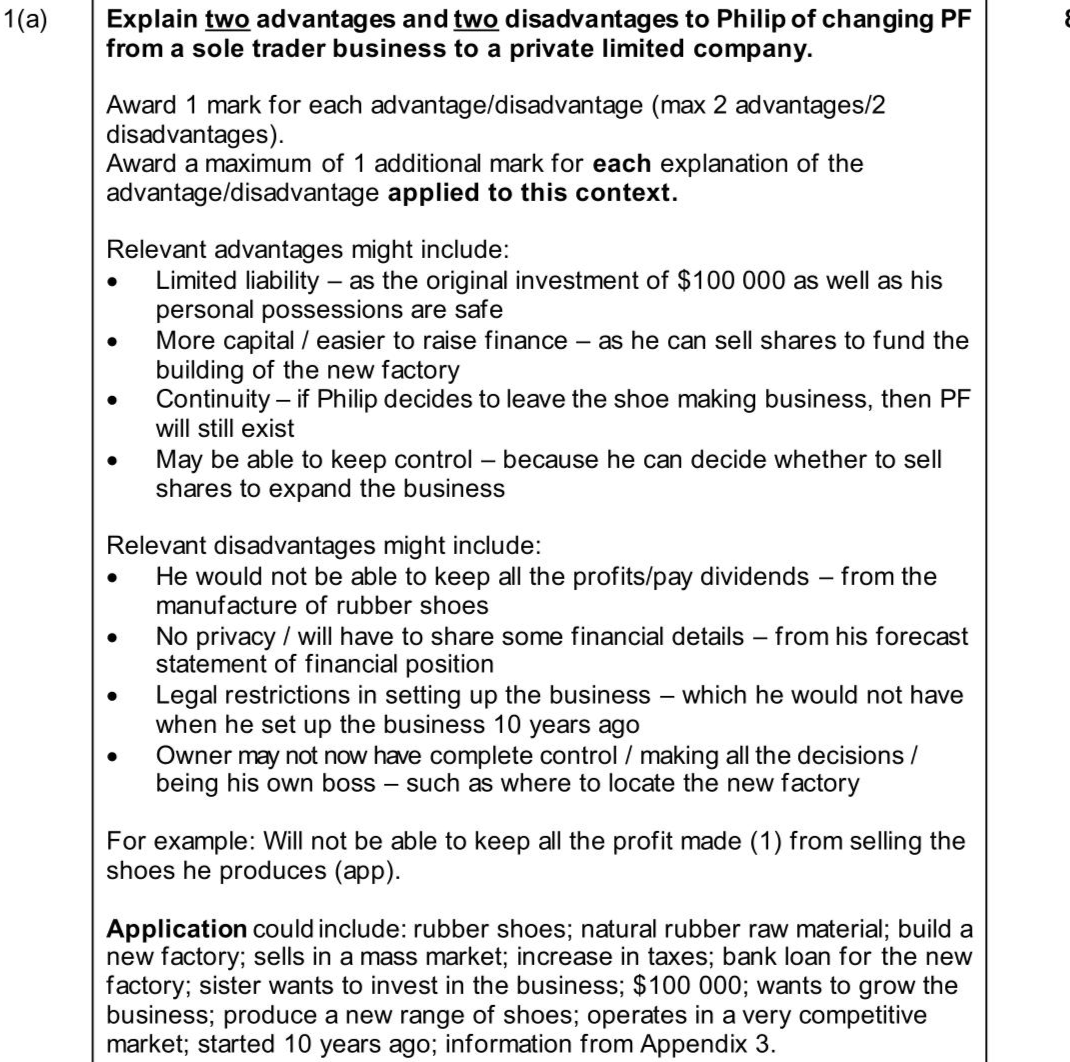
Award 1 mark for each advantage/disadvantage (max 2 advantages/2 disadvantages).
Award a maximum of 1 additional mark for each explanation of the advantage/disadvantage applied to this context.
Relevant advantages might include:
- Limited liability - as the original investment of \(\$ 100000\) as well as his personal possessions are safe
- More capital / easier to raise finance - as he can sell shares to fund the building of the new factory
- Continuity - if Philip decides to leave the shoe making business, then PF will still exist
- May be able to keep control - because he can decide whether to sell shares to expand the business
Relevant disadvantages might include:
- He would not be able to keep all the profits/pay dividends - from the manufacture of rubber shoes
- No privacy / will have to share some financial details - from his forecast statement of financial position
- Legal restrictions in setting up the business - which he would not have when he set up the business 10 years ago
- Owner may not now have complete control / making all the decisions / being his own boss - such as where to locate the new factory
For example: Will not be able to keep all the profit made (1) from selling the shoes he produces (app).
Application could include: rubber shoes; natural rubber raw material; build a new factory; sells in a mass market; increase in taxes; bank loan for the new factory; sister wants to invest in the business; \(\$ 100000\); wants to grow the business; produce a new range of shoes; operates in a very competitive market; started 10 years ago; information from Appendix 3.
Award a maximum of 1 additional mark for each explanation of the advantage/disadvantage applied to this context.
Relevant advantages might include:
- Limited liability - as the original investment of \(\$ 100000\) as well as his personal possessions are safe
- More capital / easier to raise finance - as he can sell shares to fund the building of the new factory
- Continuity - if Philip decides to leave the shoe making business, then PF will still exist
- May be able to keep control - because he can decide whether to sell shares to expand the business
Relevant disadvantages might include:
- He would not be able to keep all the profits/pay dividends - from the manufacture of rubber shoes
- No privacy / will have to share some financial details - from his forecast statement of financial position
- Legal restrictions in setting up the business - which he would not have when he set up the business 10 years ago
- Owner may not now have complete control / making all the decisions / being his own boss - such as where to locate the new factory
For example: Will not be able to keep all the profit made (1) from selling the shoes he produces (app).
Application could include: rubber shoes; natural rubber raw material; build a new factory; sells in a mass market; increase in taxes; bank loan for the new factory; sister wants to invest in the business; \(\$ 100000\); wants to grow the business; produce a new range of shoes; operates in a very competitive market; started 10 years ago; information from Appendix 3.
Knowledge points:
1.4.1.1. Sole traders, partnerships, private and public limited companies, franchises and joint ventures
1.4.1.2. Differences between unincorporated businesses and limited companies
1.4.1.3. Concepts of risk, ownership and limited liability
1.4.1.4. Recommend and justify a suitable form of business organisation to owners/management in a given situation
1.4.1.5. Business organisations in the public sector, e.g. public corporations
Solution:
Download APP for more features
1. Tons of answers.
2. Smarter Al tools enhance your learning journey.
IOS
Download
Download
Android
Download
Download
Google Play
Download
Download