
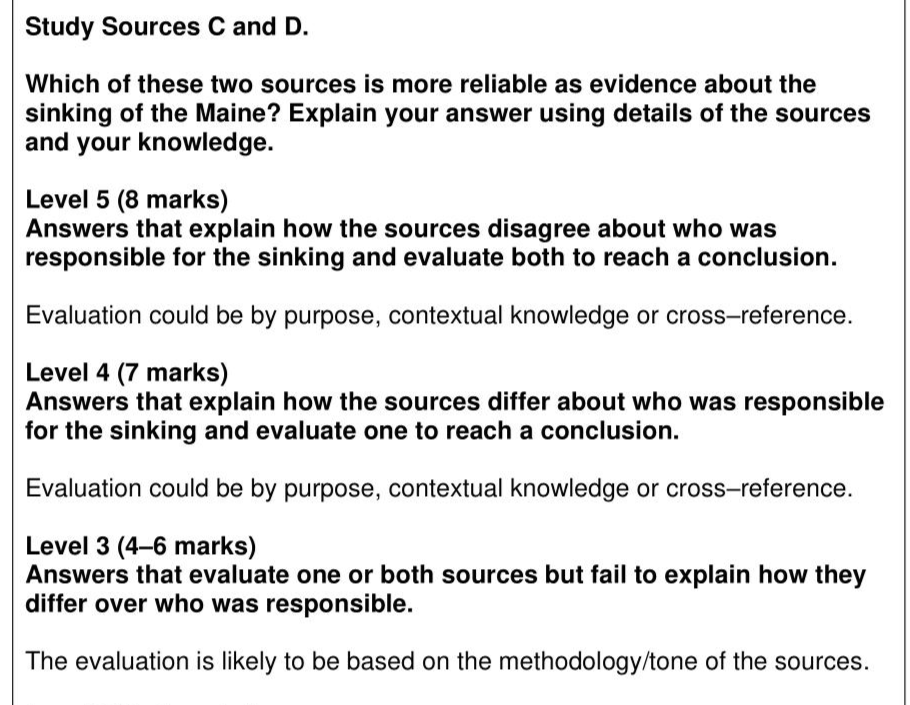
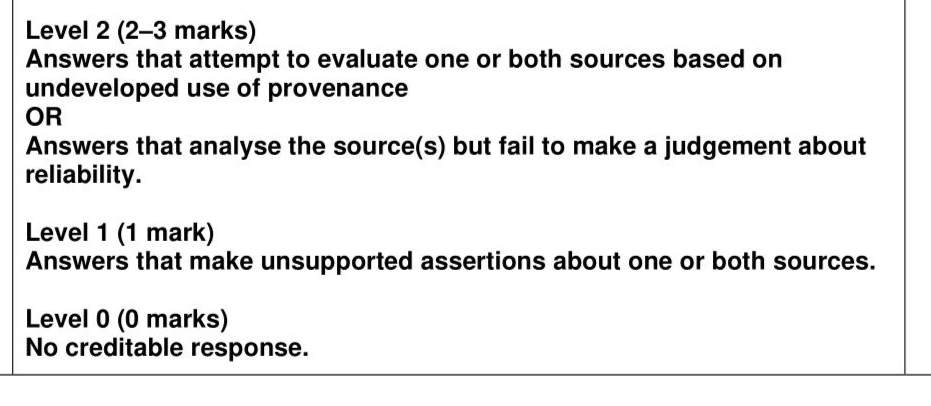
Did Americans blame Spain for the sinking of the Maine? Study the Background Information and the sources carefully, and then answer all parts of Question 1. Background Information As soon as the American warship USS Maine exploded and sank in the Cuban port of Havana on 15 February 1898, newspapers and politicians in the United States began to blame the Spanish. Even before there was any evidence, claims were made that a Spanish mine (a floating bomb) had destroyed the warship. President McKinley was more cautious and set up a court of inquiry. Popular newspapers, led by the New York Journal and the New York World, also made claims about Spanish cruelty towards the Cubans who were fighting for independence from Spanish rule, and demanded that America go to war to free Cuba. Did all Americans blame the Spanish for the sinking of the Maine? SOURCE A This has been a busy day. We have been overwhelmed with callers, expressing sympathy. The entire staff of the Spanish embassy called to express regrets. The records show that 253 men were killed. There is an intense difference of opinion as to the cause of the sinking of the Maine. The opinion of each individual is determined by his bias. If he is a conservative, he is sure that it was an accident; if he is a jingo, he is sure it was deliberate. My own judgement is that it was the result of an accident such as a ship of war carrying powerful explosives is likely to experience. John D Long, US Secretary of the Navy, writing in his journal, 16 February 1898. Long was the member of the government in charge of the navy. A jingo was a strong supporter of war against Spain for patriotic reasons. SOURCE B It would be wasting our time to discuss the American theory that the Maine was blown up by the explosion of a mine connected by wires to our shipyard. Spain's honour stands too high to be harmed by the squeamish drivel of those nasty American jingoes. The best way to get rid of these toads is to crush them. The American jingoes believe that all men are made like themselves. It was President McKinley's duty to see that Spain should not be so grossly insulted by the jingo newspapers. Since he did not do so, he is as much a jingo as the jingo newspapers. We must declare that the claim that the Maine was blown up by us is laughable. What reason could we have for destroying the American battleship? Even ten ships would not enable the United States to triumph over Spain. From a Spanish newspaper published in Madrid, 1 March 1898. SOURCE C To five hundred thousand Cubans starved or otherwise murdered by the Spanish have been added an American battleship and three hundred American sailors lost as the direct result of the policy of our government. The Spanish claim it was an accident. If it was an accident, it was remarkably convenient for Spain. Two years ago our naval superiority over Spain was overwhelming. Our government allowed Spain to overcome that disadvantage by building enough ships to bring its navy up to equality with ours. This 'accidental' destruction of the American fleet means it will not take long for Spain's naval strength to overtake our own. If it be found that Spain caused this disaster, no power will be able to restrain the American people from taking a justifiable revenge. All the circumstances fix the burden of proof upon Spain. The Maine was lying in one of its harbours, under the guns of its fortresses. The destruction of the Maine strengthens Spain in the event of the war that Spain desires. The chances against such a destruction by accident were millions to one, and yet it occurred. The investigations must clearly prove Spain's innocence or its guilt will be assumed. From the New York Journal, 17 February 1898. SOURCE D INSPECTION OF THE MAINE WILL DECIDE Divers Will Inspect the Ship to Find Out Whether the Explosion Was From the Outside or Inside Magazines of Warships Sometimes Blow Up Because of Too Much Heat Inside - Hard to Blow Up the Magazine from the Outside The warship Maine was destroyed in Havana harbour last night. Secretary Long was asked whether he thought this was the work of the enemy. He replied: 'I do not. I am influenced by the fact that Captain Sigsbee has not yet reported. He is waiting to write a full report. So long as he has not made a decision, I certainly cannot. I should think from the signs, however, that there was an accident - that the magazine exploded. How that came about I do not know.' A naval officer, who knows a great deal about warships, dismissed the idea that the Maine had been destroyed on purpose. He said that fires sometimes started in the coal bunkers, and he told of such a fire very close to the magazine on board another warship. The fire became so hot that the steel wall between the fire and the ammunition melted. He did not believe that the Spanish had either the information or the equipment necessary to blow up the magazine. From the New York Times, 17 February 1898. The magazine is where the ship's ammunition is stored. Captain Sigsbee was captain of the Maine. SOURCE E SOURCE F Now answer all parts of Question 1. You may use any of the sources to help you answer the questions, in addition to those sources which you are told to use. In answering parts (a)-(e) you should use your knowledge of the topic to help you interpret and evaluate the sources. Study Sources C and D. Which of these two sources is more reliable as evidence about the sinking of the Maine? Explain your answer using details of the sources and your knowledge.
Exam No:0470_w24_qp_21 Year:2024 Question No:1(b)
Answer:
Knowledge points:
1.1 The nineteenth century: the development of modern nation states, 1848–1914
1.2 The twentieth century: international relations from 1919
Solution:
Download APP for more features
1. Tons of answers.
2. Smarter Al tools enhance your learning journey.
IOS
Download
Download
Android
Download
Download
Google Play
Download
Download