
GAE is a multinational company. It manufactures steel. GAE has 2400 employees and has factories in 4 countries. The business regularly introduces new technology. Holding inventory is important. GAE's directors are planning to build a new factory and want to know how legal controls over location might affect this decision. The Managing Director said, 'The new factory will create many external benefits.' (e)Explain two benefits to a business of being a multinational company.Which benefit is likely to be the most important?Justify your answer. .......................................................................................................................................
Exam No:0450_s25_qp_13 Year:2025 Question No:3(e)
Answer:
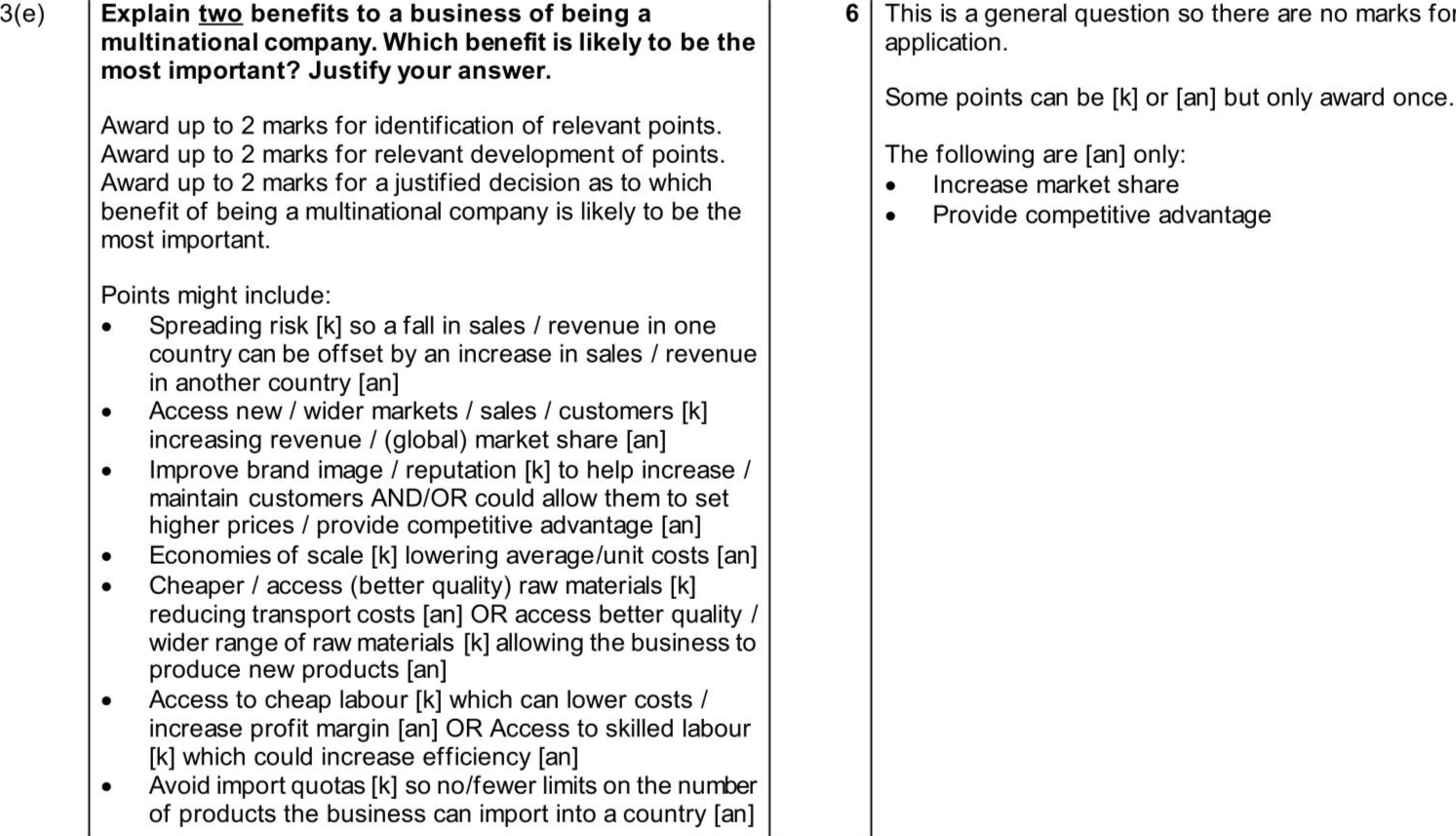
Award up to 2 marks for identification of relevant points. Award up to 2 marks for relevant development of points. Award up to 2 marks for a justified decision as to which benefit of being a multinational company is likely to be the most important.
Points might include:
- Spreading risk [k] so a fall in sales / revenue in one country can be offset by an increase in sales / revenue in another country [an]
- Access new / wider markets / sales / customers [k] increasing revenue / (global) market share [an]
- Improve brand image / reputation [k] to help increase / maintain customers AND/OR could allow them to set higher prices / provide competitive advantage [an]
- Economies of scale [k] lowering average/unit costs [an]
- Cheaper / access (better quality) raw materials [k] reducing transport costs [an] OR access better quality / wider range of raw materials \([\mathrm{k}]\) allowing the business to produce new products [an]
- Access to cheap labour [k] which can lower costs / increase profit margin [an] OR Access to skilled labour [k] which could increase efficiency [an]
- Avoid import quotas \([\mathrm{k}]\) so no/fewer limits on the number of products the business can import into a country [an]
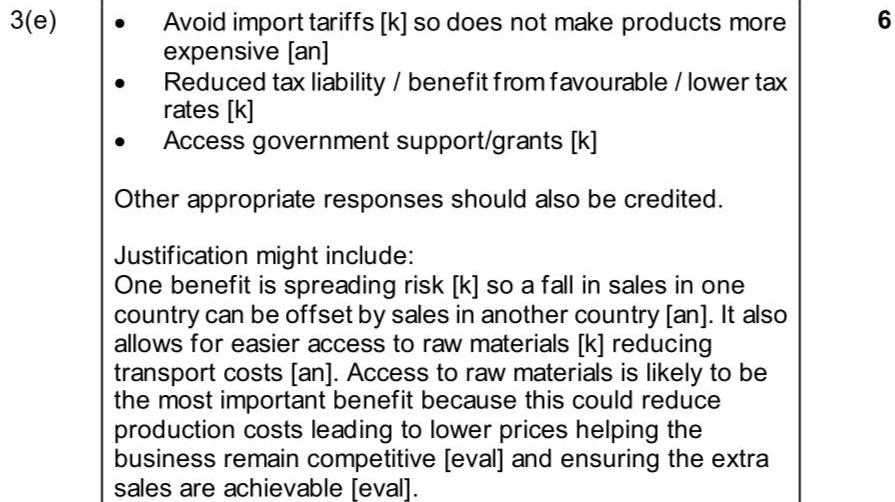
- Avoid import tariffs [k] so does not make products more expensive [an]
- Reduced tax liability / benefit from favourable / lower tax rates [k]
- Access government support/grants [k]
Other appropriate responses should also be credited.
Justification might include:
One benefit is spreading risk \([\mathrm{k}]\) so a fall in sales in one country can be offset by sales in another country [an]. It also allows for easier access to raw materials [k] reducing transport costs [an]. Access to raw materials is likely to be the most important benefit because this could reduce production costs leading to lower prices helping the business remain competitive [eval] and ensuring the extra sales are achievable [eval].
Points might include:
- Spreading risk [k] so a fall in sales / revenue in one country can be offset by an increase in sales / revenue in another country [an]
- Access new / wider markets / sales / customers [k] increasing revenue / (global) market share [an]
- Improve brand image / reputation [k] to help increase / maintain customers AND/OR could allow them to set higher prices / provide competitive advantage [an]
- Economies of scale [k] lowering average/unit costs [an]
- Cheaper / access (better quality) raw materials [k] reducing transport costs [an] OR access better quality / wider range of raw materials \([\mathrm{k}]\) allowing the business to produce new products [an]
- Access to cheap labour [k] which can lower costs / increase profit margin [an] OR Access to skilled labour [k] which could increase efficiency [an]
- Avoid import quotas \([\mathrm{k}]\) so no/fewer limits on the number of products the business can import into a country [an]
- Avoid import tariffs [k] so does not make products more expensive [an]
- Reduced tax liability / benefit from favourable / lower tax rates [k]
- Access government support/grants [k]
Other appropriate responses should also be credited.
Justification might include:
One benefit is spreading risk \([\mathrm{k}]\) so a fall in sales in one country can be offset by sales in another country [an]. It also allows for easier access to raw materials [k] reducing transport costs [an]. Access to raw materials is likely to be the most important benefit because this could reduce production costs leading to lower prices helping the business remain competitive [eval] and ensuring the extra sales are achievable [eval].
Knowledge points:
6.3.1.1. The concept of globalisation and the reasons for it
6.3.1.2. Opportunities and threats of globalisation for businesses
6.3.1.3. Why governments might introduce import tariffs and import quotas
6.3.2.1. Benefits to a business of becoming a multinational and the impact on its stakeholders
6.3.2.2. Potential benefits to a country and/or economy where a MNC is located, e.g. jobs, exports, increased choice, investment
6.3.2.3. Potential drawbacks to a country and/or economy where a MNC is located, e.g. reduced sales of local businesses, repatriation of profits
6.3.3.1. Depreciation and appreciation of an exchangerate
6.3.3.2. How exchange rate changes can affect businesses as importers and exporters of products, e.g. prices, competitiveness, profitability (exchange rate calculations will not be assessed)
Solution:
Download APP for more features
1. Tons of answers.
2. Smarter Al tools enhance your learning journey.
IOS
Download
Download
Android
Download
Download
Google Play
Download
Download